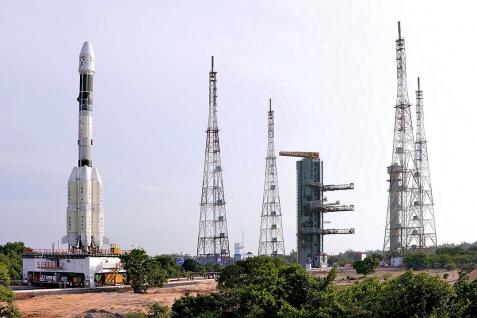
The Indian government has approved the establishment of a Third Launch Pad (TLP) at the Satish Dhawan Space Centre in Sriharikota, Andhra Pradesh. The project, aimed at supporting next-generation launch vehicles and future human spaceflight missions, was approved during a cabinet meeting chaired by Prime Minister Narendra Modi. The initiative is expected to enhance India’s launch capacity and serve as a backup for the existing Second Launch Pad. It is also designed to accommodate future heavy-lift launch vehicles, including those equipped with semi-cryogenic stages.
The total investment for the Third Launch Pad is ₹3,984.86 crore, which will cover the development of the launch pad and associated facilities. The project is targeted for completion within four years. The facility will feature a versatile design, enabling it to support multiple launch configurations such as Next Generation Launch Vehicles (NGLV) and LVM3, making it adaptable for evolving mission requirements.
India’s current space transportation infrastructure consists of two operational launch pads at Sriharikota. The First Launch Pad, which has been in use for 30 years, supports PSLV and SSLV missions. The Second Launch Pad, operational for 20 years, is primarily used for GSLV and LVM3 launches and also functions as a backup for PSLV missions. The Second Launch Pad has played a critical role in several significant missions, including the Chandrayaan-3 mission, and is being prepared for human-rated launches under the Gaganyaan program.
The establishment of a Third Launch Pad is part of a broader plan to meet the growing requirements of India’s space program. With future initiatives such as the Bharatiya Antariksh Station planned by 2035 and a crewed lunar mission targeted for 2040, the new launch pad will enable the deployment of heavier launch vehicles, ensuring that India can meet the demands of its evolving space transportation needs over the next 25 to 30 years. This development reflects the increasing focus on advancing the country’s capabilities in space exploration and human spaceflight.
On Date: