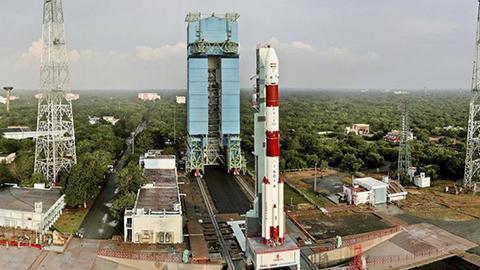
The European Space Agency (ESA) launched its Proba-3 mission, a two-satellite system designed for solar observation, aboard the Indian Space Research Organisation’s (ISRO) PSLV-XL rocket on December 5, following a one-day delay due to a technical issue.
The launch took place at 1034 GMT from the Satish Dhawan Space Centre, with mission director M. Jayakumar confirming at 1058 GMT that the satellite was successfully placed into orbit. The mission aims to study the sun’s corona, a region critical to understanding solar phenomena that can impact Earth’s communication, navigation systems, and power grids.
The €200 million ($210 million) mission is backed by over 40 European companies, including SENER Aerospace, Redwire Space, and Airbus Defence and Space. It enables observations of the sun’s inner corona for up to six hours per orbit, significantly extending the study duration compared to natural solar eclipses.
Proba-3 complements ESA’s Solar Orbiter in advancing solar research. The mission is part of ESA's efforts to mitigate risks associated with space weather, which can pose economic and technological challenges.
ESA selected ISRO's PSLV-XL rocket for its cost efficiency and performance, amid delays in ESA’s Ariane 6 heavy launcher program and disrupted access to Russia’s Soyuz rockets due to geopolitical tensions.
Proba-3 follows recent achievements by ISRO, including the Chandrayaan-3 lunar landing and the Aditya-L1 solar observatory.
On Date: