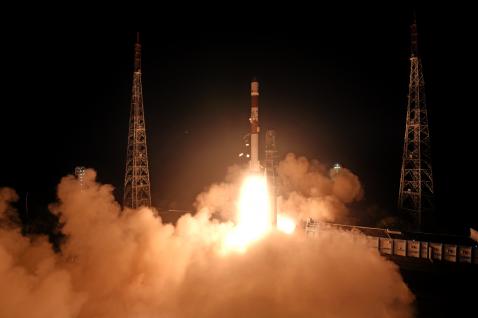
India's Space Research Organisation (ISRO) has successfully demonstrated space docking technology through its Space Docking Experiment (SpaDeX) mission. The milestone was achieved on January 16, 2025, marking the country’s entry into an exclusive group of nations with this capability.
The mission involved two small spacecraft, SDX01 (Chaser) and SDX02 (Target), weighing approximately 220 kilograms each. These spacecraft were launched on December 30, 2024, aboard the PSLV-C60 from the Satish Dhawan Space Centre in Sriharikota. The satellites were designed to autonomously rendezvous and dock, a critical capability for future applications such as satellite servicing, space station operations, and interplanetary exploration.
Mission Details and Objectives
The docking procedure was executed with precise control, involving maneuvers from a 15-meter hold point to a 3-meter proximity before successfully completing docking, retraction, and stabilization. Following docking, the spacecraft were operated as a single unit, with power transferred between them to validate system performance. Future plans include undocking operations and additional testing.
The primary objectives of the SpaDeX mission include:
- Demonstrating autonomous rendezvous and docking technology.
- Testing controllability in a docked state.
- Extending spacecraft operational lifespans.
- Validating power transfer between docked units.
The mission also incorporated indigenous technologies, such as a docking mechanism, an inter-satellite communication link, and a novel orbit determination processor. These innovations aim to advance India's space technology capabilities.
Applications and Future Implications
Post-docking, the spacecraft will perform payload operations, including high-resolution imaging, natural resource monitoring, vegetation studies, and radiation environment measurements. These capabilities are expected to find applications in various sectors.
The success of SpaDeX is a significant step for India’s future space missions, including the development of the Bharatiya Antariksh Station and lunar exploration initiatives like Chandrayaan-4. It also contributes to preparations for the Gaganyaan mission, which aims to send Indian astronauts to space.
This achievement underscores ISRO’s advancements in autonomous space technologies and positions India for more complex space endeavors in the future.
On Date: